

The complete guide
Choosing a Switch and Light Busy Board for Your Child
When every switch draws their attention
Some children notice switches wherever they go. A light turns on, a control moves, and they want to try it again. That interest can make everyday routines tricky when the controls belong to household equipment rather than a toy.
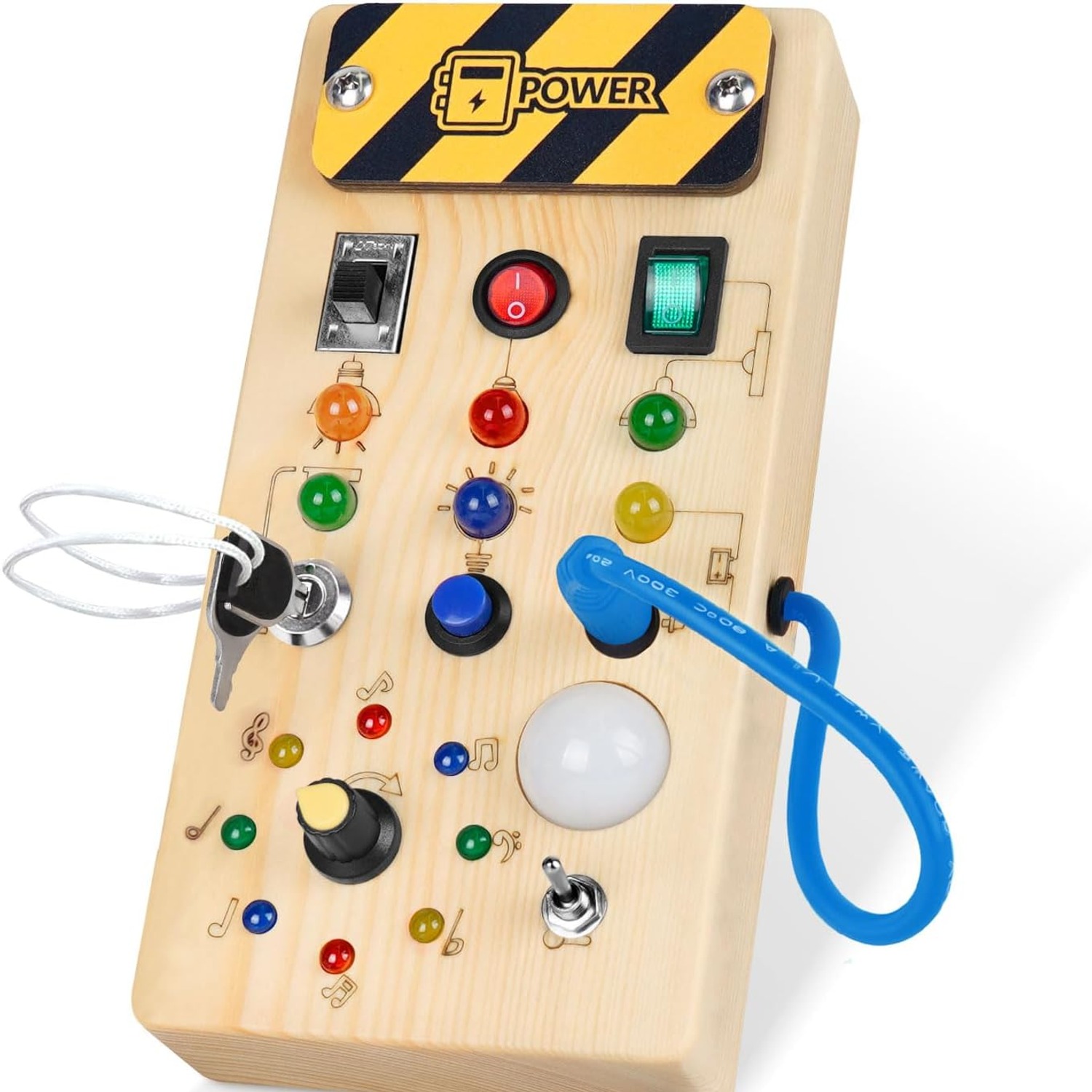
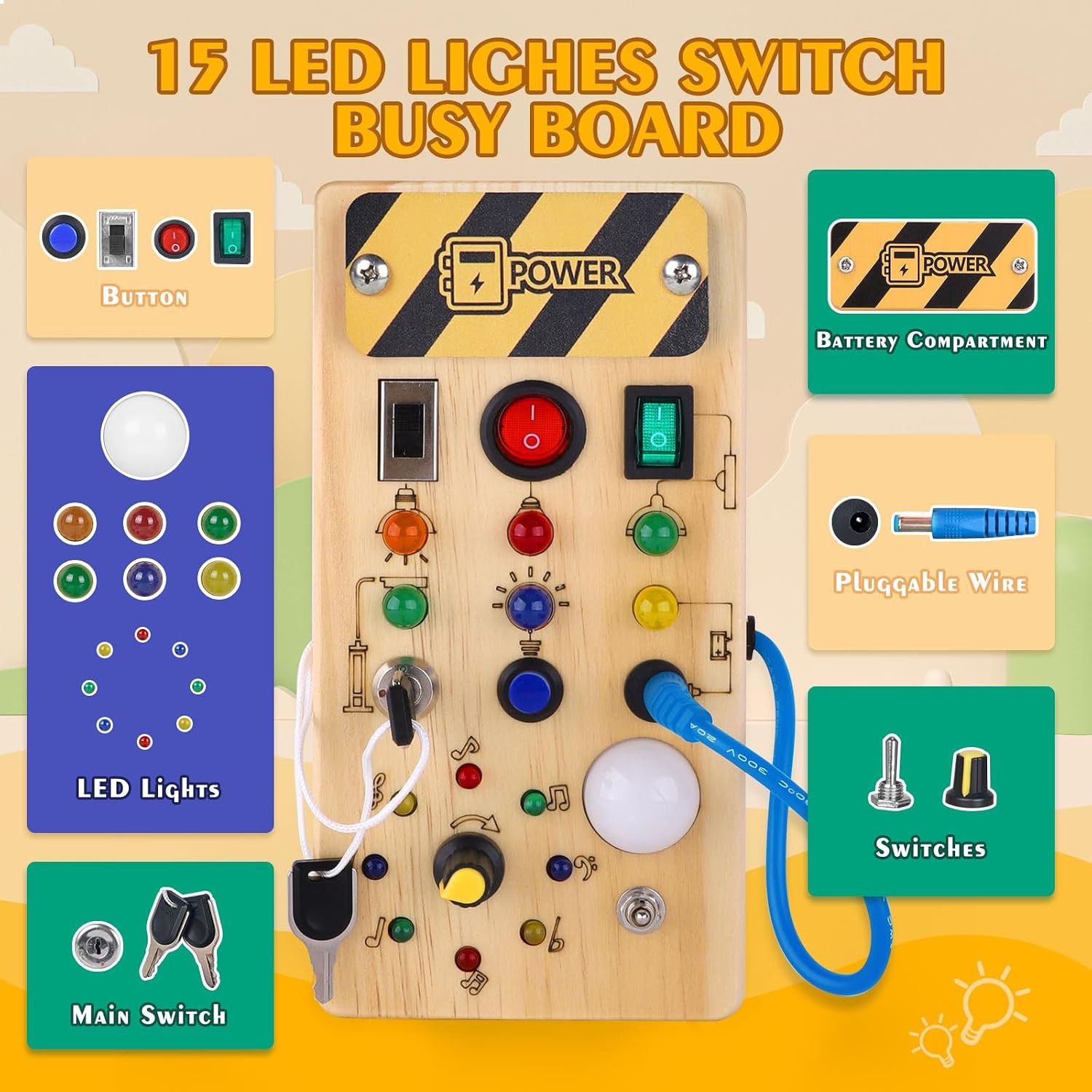
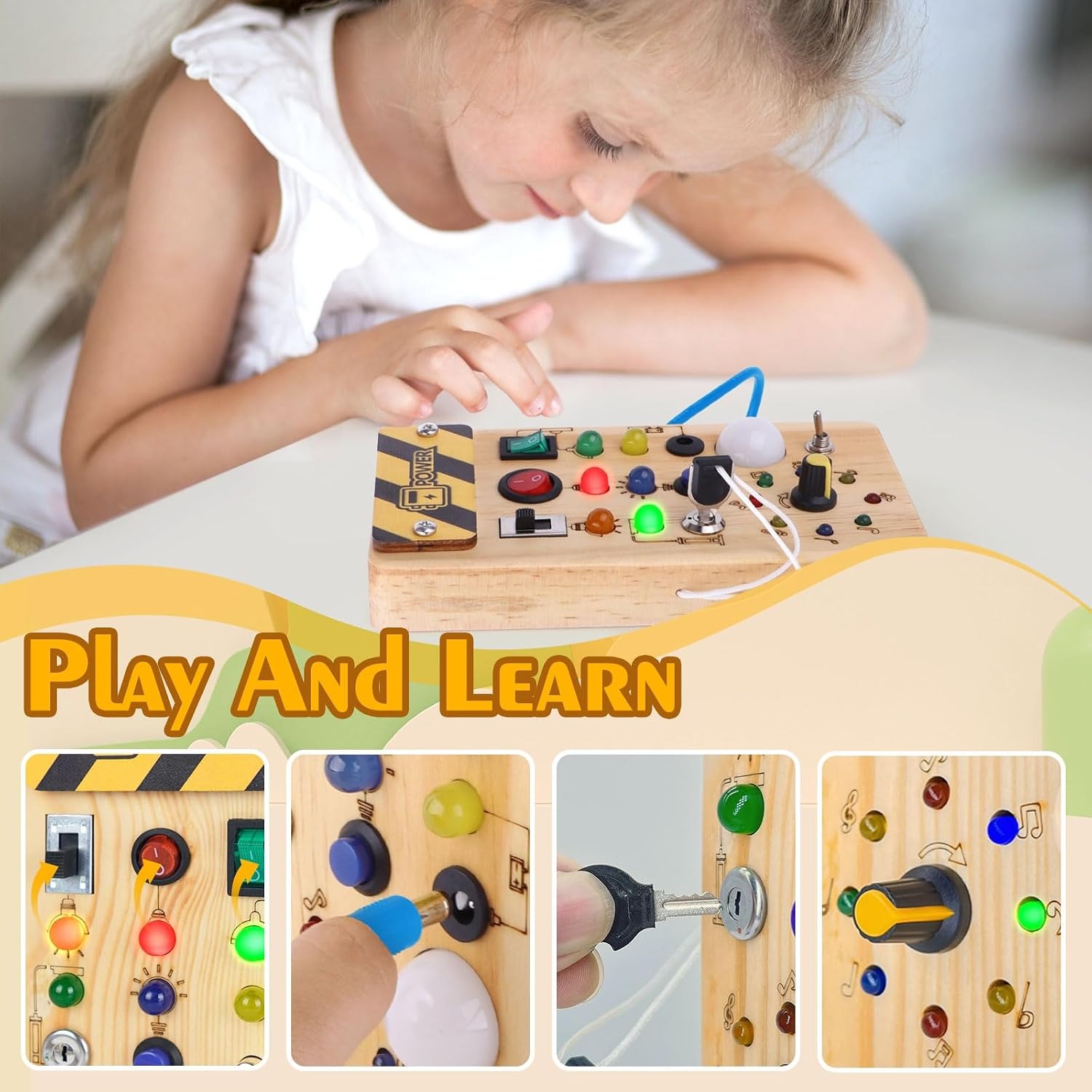
A Montessori Busy Board offers a dedicated activity built around that curiosity. This model has eight different switches, each linked to an LED light. It gives a child something specific to move and watch during supervised play.
The appeal is straightforward. A child tries a control, sees a result and decides whether to repeat it. There is no need to create a lesson plan or expect a certain amount of play time. The useful question is whether that kind of activity fits your child.
What this board actually offers
This is a switch and light board, rather than a collection of dressing tasks or puzzles. If you are comparing busy boards, that distinction matters. A board with laces or buckles offers a different experience from an educational switch toy.
Here, the focus is on eight different controls and their corresponding LED lights. The lights vary in colour or style, giving children visual differences to notice as they explore.
The product details list wood as the material and brown as the colour. They also list manual operation, battery power and no assembly requirement. Two AAA alkaline batteries are needed and must be bought separately.
Knowing those basics helps set fair expectations. You are choosing a compact activity focused on switches, not a toy with a confirmed range of sounds, puzzles or adjustable light settings.
How switch play can become a shared activity
The simplest way to introduce the board is to place it on a suitable stable surface and let your child look. Show one control if needed, then give them time to respond. Repeated demonstrations can sometimes get in the way of their own exploration.
If a light appears, describe what you both see. Short comments such as “That light came on” connect the action with the result without turning play into a quiz.
A cause and effect toy can also give you a chance to wait. Your child may try the same switch several times before touching another one. That does not mean the activity needs fixing or making harder.
Keep any learning claims modest. The record lists cognitive skill as the educational objective, but it does not provide evidence for a measured improvement. The immediate value is the hands-on experience itself.
Who is likely to enjoy it?
Start with interests rather than age alone. A child who repeatedly seeks out switches may be more drawn to this board than one who prefers pretend cooking, building or drawing.
The manufacturer lists a recommended age of 12 months to 12 years, while the audience description says toddler. That is a wide range. It should not be read as a promise that the toy will offer the same challenge to a one-year-old and a much older child.
For a younger child, follow the packaging guidance and supervise closely. For an older child, think about whether simple switch-and-light play still appeals.
A Montessori toddler toy does not need to hold attention for long stretches to have a place in a play area. Short, interested sessions may suit your household better than expecting one toy to fill an afternoon.
Check the size before you choose
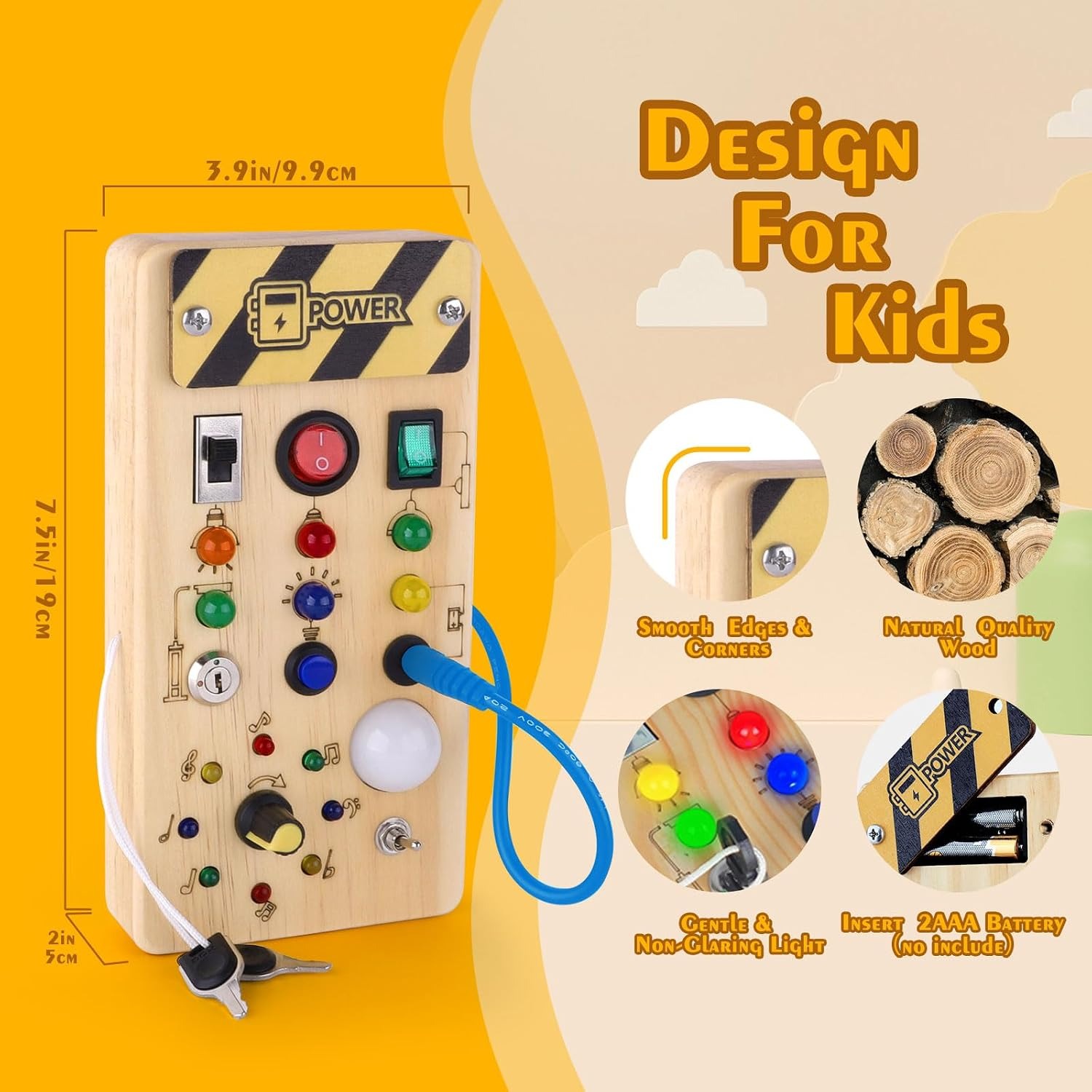
The recorded dimensions are 20 x 5 x 10.1 cm, and the listed weight is 0.28 kg. These figures are more useful than the supplier's broad size labels when deciding where the board will fit.
Compare the measurements with the shelf, bag or play surface you plan to use. Pictures can make a compact activity board look larger or smaller than expected, especially when there is no familiar object beside it.
Think about how your child will reach the controls too. A stable setup lets them focus on the activity instead of trying to hold the board and work a switch at once.
The weight may make it convenient for an adult to carry, but it does not tell you how easily a particular child will handle it. Watch the first few sessions and adjust the setup as needed.
Preparing the board for first use
No assembly is required, but the toy still needs adult preparation. Read the supplied instructions, fit two AAA alkaline batteries and follow the polarity markings in the compartment.
Make sure the battery compartment closes and secures as intended. The record does not specify its fastening method, so check the actual product rather than assuming it uses a particular type of closure.
Before handing it over, inspect the surface and controls. If anything is cracked, loose or damaged, do not use it until the issue has been addressed.
Keep spare and used batteries away from children. Battery changes are an adult task, not part of the play activity. Follow the instructions supplied with the board for replacement and storage.
A screen-free option without big promises
A toddler switch toy can offer a different pace from watching a screen. The child makes a physical movement and sees a direct response, rather than following a video or tapping through an app.
That makes this board a possible screen-free toddler activity, but it is not a guarantee of longer attention or calmer behaviour. Some children will return to the controls often. Others may explore them briefly and move on.
Try offering it when your child is rested and ready to play. Avoid making the board a test of whether they can sit still.
If interest fades, put it away and offer it another time. There is no need to keep prompting a child to use every switch or identify every colour.
Thinking about lights and sensory preferences
A light switch sensory toy combines touch, movement and visual feedback. That combination may appeal to a child who enjoys watching a small change happen when they act.
Preferences differ, though. Some children seek out lights, while others find certain visual effects uncomfortable. Introduce the board gently and pay attention to your child's response.
The record does not specify a user-adjustable brightness setting, detailed light patterns or sensory suitability testing. It would be unwise to choose it on the assumption that the lights can be dimmed.
Use it in a comfortable setting and stop if your child turns away, shields their eyes or seems distressed. A toy does not need to suit every child to suit some children well.
Taking a busy board away from home
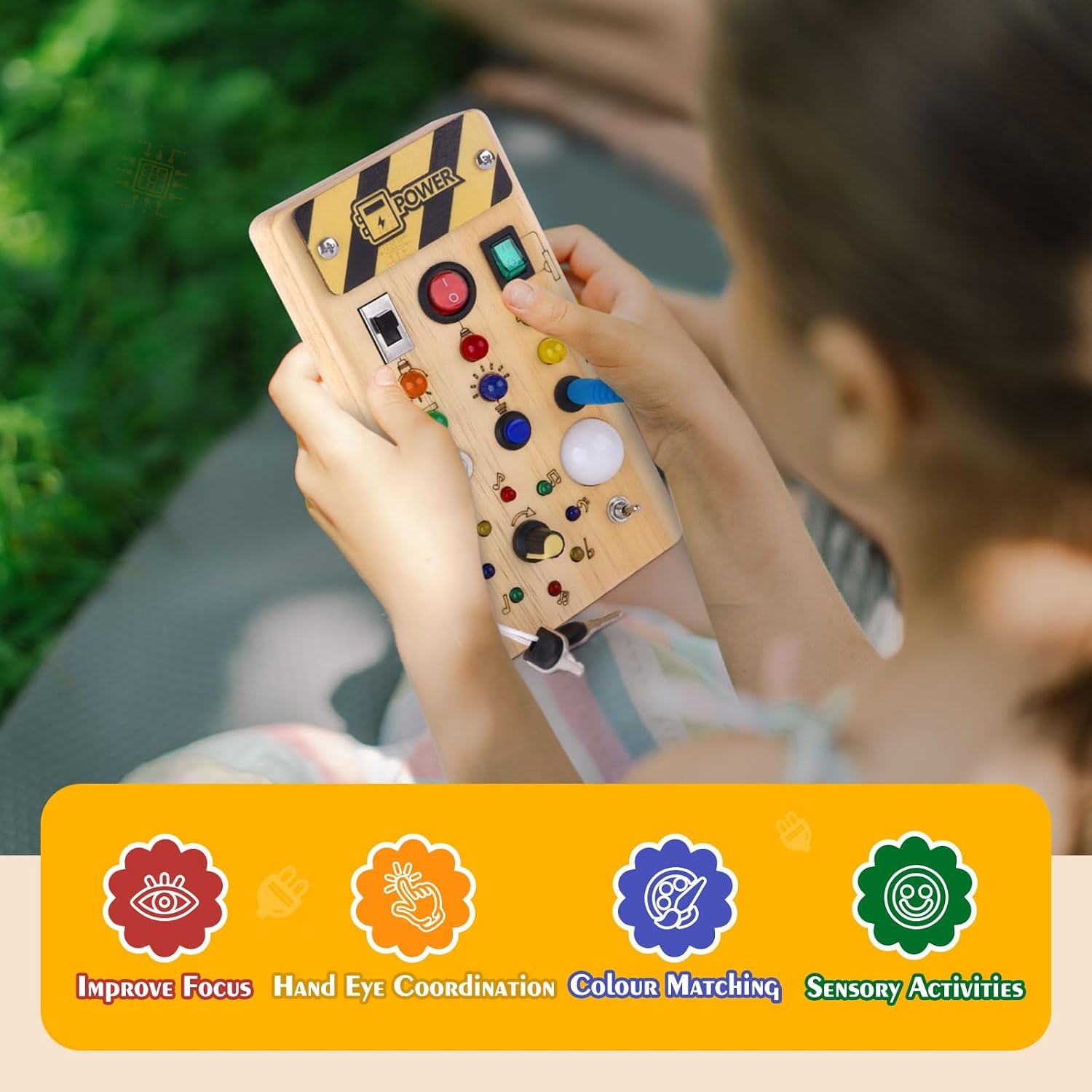
The dimensions and weight make this board worth considering as a toddler travel toy. Check that it fits your bag alongside the things you already need, rather than packing it based on photos alone.
Travel use still needs thought. Choose a setting where an adult can supervise and where the board will not distract a driver. Follow any transport rules that apply.
Do not count on it to guarantee a quiet flight or a settled journey. The record does not give a noise level for the controls, and lights may draw attention in a dim cabin.
A familiar toy can be one option during a trip, but keep expectations flexible. Sometimes a child wants the activity you packed. Sometimes they need a break, movement or your attention instead.
Care that respects the electrical parts
A wooden busy board with battery-powered lights needs different care from a plain wooden block. Avoid soaking it, rinsing it under a tap or letting water enter the switches.
Follow the supplied cleaning directions. For routine surface care, use a soft cloth and keep moisture away from electrical parts. Do not assume it can tolerate disinfectants or other cleaners unless the instructions say so.
Check its condition regularly, especially after travel or a drop. Look for loose controls, damage to the body and any problem with the battery compartment.
Store it somewhere dry when play is finished. For longer storage, follow the supplied battery guidance. A quick inspection before the next session is a sensible habit.
Choosing it as a gift
This board may be a thoughtful toddler birthday gift when you already know the child likes controls and lights. Ask the caregiver whether that interest matches the child's current play and whether they are comfortable with a battery-powered toy.
Include the practical details. It needs two AAA alkaline batteries, and they are not included. Passing that information on can save a search for batteries when the gift is opened.
Check delivery estimates for the recipient's address before ordering for an occasion. No fixed delivery timeframe is supplied in this record.
Read the store's current return terms as well. Gift suitability can be hard to judge, even when the age range looks right.
The short version
Choose this board if you want a compact wooden activity focused on eight switches and their LED responses. Check its 20 x 5 x 10.1 cm dimensions, plan for two AAA batteries and follow the supplied age and safety guidance.
Most importantly, match the activity to the child. An interest in switches is a better starting point than a promise of long play sessions. Offer it with supervision, allow room for repeated exploration and let your child's response guide what happens next.